
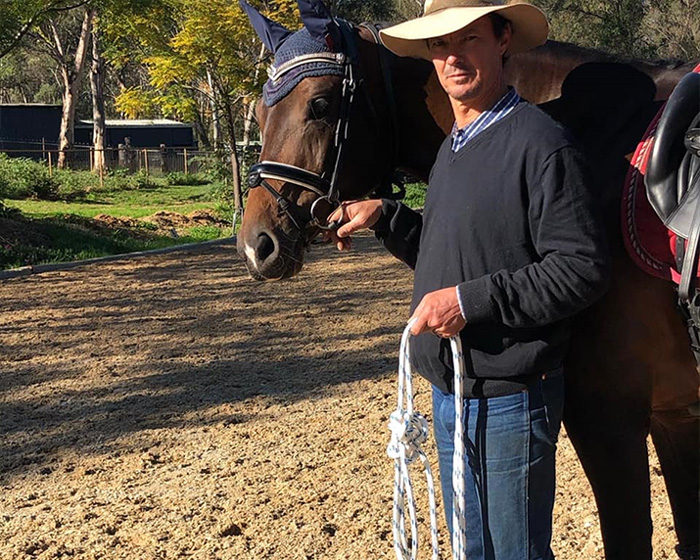
Building core muscle to cope with the demands of our sport.
We believe that stretching young horses to build core muscle to carry their riders is the best way to enable them to cope with the demands of their sport.
I am driven to find what will help the horses find their job easy. If a young horse is taught quietly and methodically how to carry their rider from the start, I believe this helps them to have a long and happy career. We do this with a very specific system of longeing and long reining.
When a young horse first has to carry the rider, the rider’s weight is placed over the middle of the spinal column, this due to a lack of correct muscle causes the young horses back to dip, he can then begin all sorts of crookedness and behaviors to avoid or alleviate pain.
Our goal as riders is to teach the horse to move with fluidity and grace under their rider. Evolution did not change the horse’s spine and biomechanics to carry a rider. He is strong in his hind quarters and shoulders but not strong in his back, he not only has to carry his heavy tummy but also a rider ( that he wasn’t designed to carry) remember he has no core muscles yet to help hold up his tummy or you.
So, what is Biomechanics? It is the study of the mechanics of a living body and the forces exerted by muscles and gravity on the skeletal structure. When you take a horses structure into account, you realise that if started incorrectly horses can have a very poor idea of being ridden and how we humans use them.
Christopher Bartle says that ‘an understanding of biomechanics and the way the muscles work is crucial to achieving this athleticism in a horse. The key to performance in the sport horse is the back. The overall aim of training is to strengthen this bridge between the forehand and the hindquarters and so enable the power from the hindquarters to flow uninterrupted, over a supple longissimus dorsi (long back muscle) to an independently carried forehand. ‘
So, Greg and I start at the very beginning. Greg developed a system to develop and engage strong core muscles by longitudinal stretching and happily it simultaneously teaches good kind manners, by working optimally with the horses natural alignment. We can help them to grow as athletes and encourage a happy relationship with their humans.
We begin with the simple tool of longeing quietly in the walk. We teach the horse to take a nice contact and whoa so we can regulate the bend and the speed thereby teaching them to swing and relax over their backs. We progressively bring them in on small circles when their joints and trust allow and then allow them to yield through the ribs and go back out to bigger circles. Take their baby bodies super slow and easy and allow them to learn to absorb impact and build muscle. It is a huge responsibility to train a horse. They are noble and willing and their trust is a legacy to our relationship with them. When they can do simple walk, trot and canter and move from pace to pace, understanding your voice and body language, they are ready for their rider. This work is done in a few small starts from the age of two, there is no such thing as breaking a horse in in 6 weeks. It is simply not possible to teach the horse enough, to muscle him enough to carry his rider with any degree of safety for the rider and comfort for the horse.
Remember simple training is often the best start with your ropes long and shorten up when the horse is moving with balance and freedom. Don’t canter until your horse can move between the trot and the walk easily.
Take your time, muscles build slowly.
Feed correctly, rest your horse often and massage with currycomb daily if you can.
Allow your horse the same consideration you give yourself when you have sore muscles from the gym!
Be on their side, they’ll do anything for you if they understand and have the muscles to do it.